

Choosing the right community platform is a crucial decision for course creators, coaches, community managers, and anyone building an online membership business. The platform you select will directly impact your community engagement, course delivery, branding control, and member management. In this article, we present a comprehensive 'Skool vs Circle' comparison, focusing on how each platform serves the needs of community building, course delivery, and branding control.
The difference between Skool and Circle comes down to philosophy and features: Skool is an all-in-one platform built for gamified communities and course creators who want simplicity, while Circle suits serious community businesses needing flexible organization, custom branding, and advanced workflows.
If you want a fast, engagement-driven paid community with built-in gamification (the use of points, levels, and leaderboards to motivate participation and reward member activity), Skool is your pick. If you need multiple spaces, white-label branding (the ability to fully customize the platform’s appearance and domain to match your own brand, removing all Circle branding), and structured course delivery, Circle is the better community platform.
Below is a practical comparison of Skool vs Circle in 2026, based on hands-on testing of both platforms.
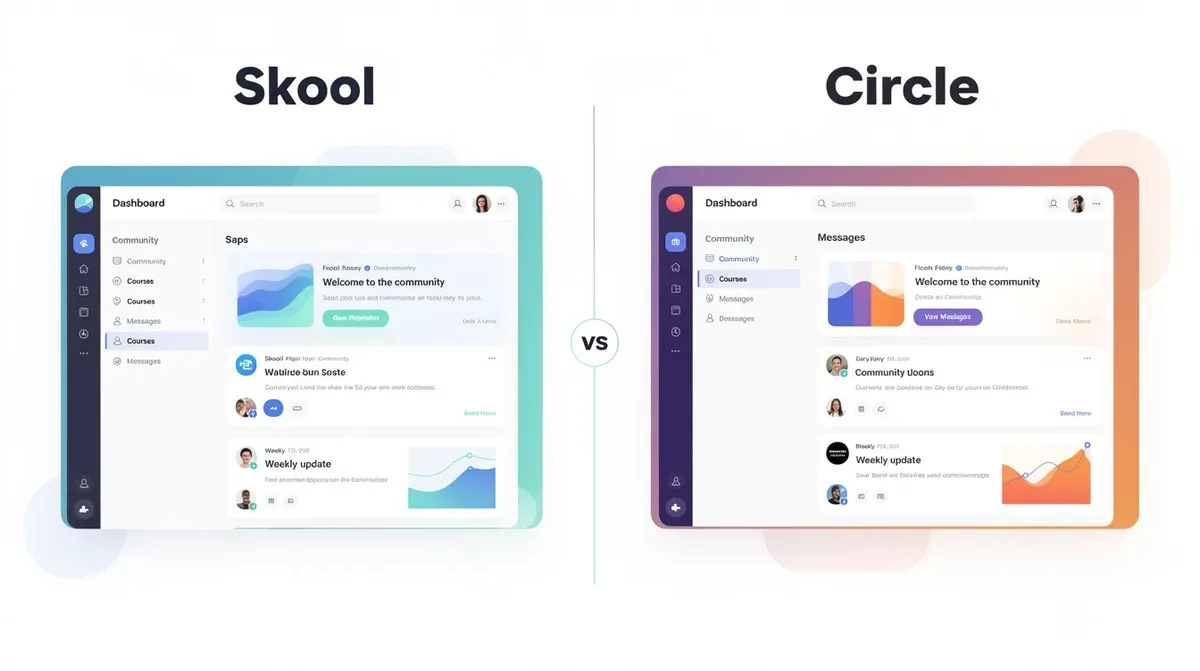
Skool vs Circle: At a Glance
Here is a quick side-by-side view of how these two community platforms stack up.
Feature | Skool | Circle |
|---|---|---|
Best For | Course creators, coaches wanting high engagement with low setup | Brands, agencies, multi-product communities needing structure and custom branding |
Ease of Use | Facebook-like interface; launchable in under an hour | Slack-inspired design; requires planning across spaces, permissions and workflows |
Key Features | Gamification (points, levels, leaderboards), unified community feed, built-in classroom, calendar | Spaces and space groups, white-labeling, custom domain, workflow automation, native live streaming |
Pricing Model | Two tiers: Hobby plan and Pro plan | Multiple tiers: Basic plan through Enterprise plan |
Free Plan / Trial | 14-day free trial | 14-day free trial |
Mobile | Mobile app access; no white-label branding | iOS and Android apps; branded experience on higher plans |
Transaction Fees | Hobby: 10% + $0.30; Pro: 2.9% + $0.30 (with platform fee on sales above $899) | Between 0.5% and 4% depending on plan tier |
The main differentiator: Skool prioritizes simplicity and high engagement through gamification. Circle focuses on flexibility and deep customization, including white-labeling. Neither is universally superior - it depends on your community business model.
Round by Round: Feature Comparison
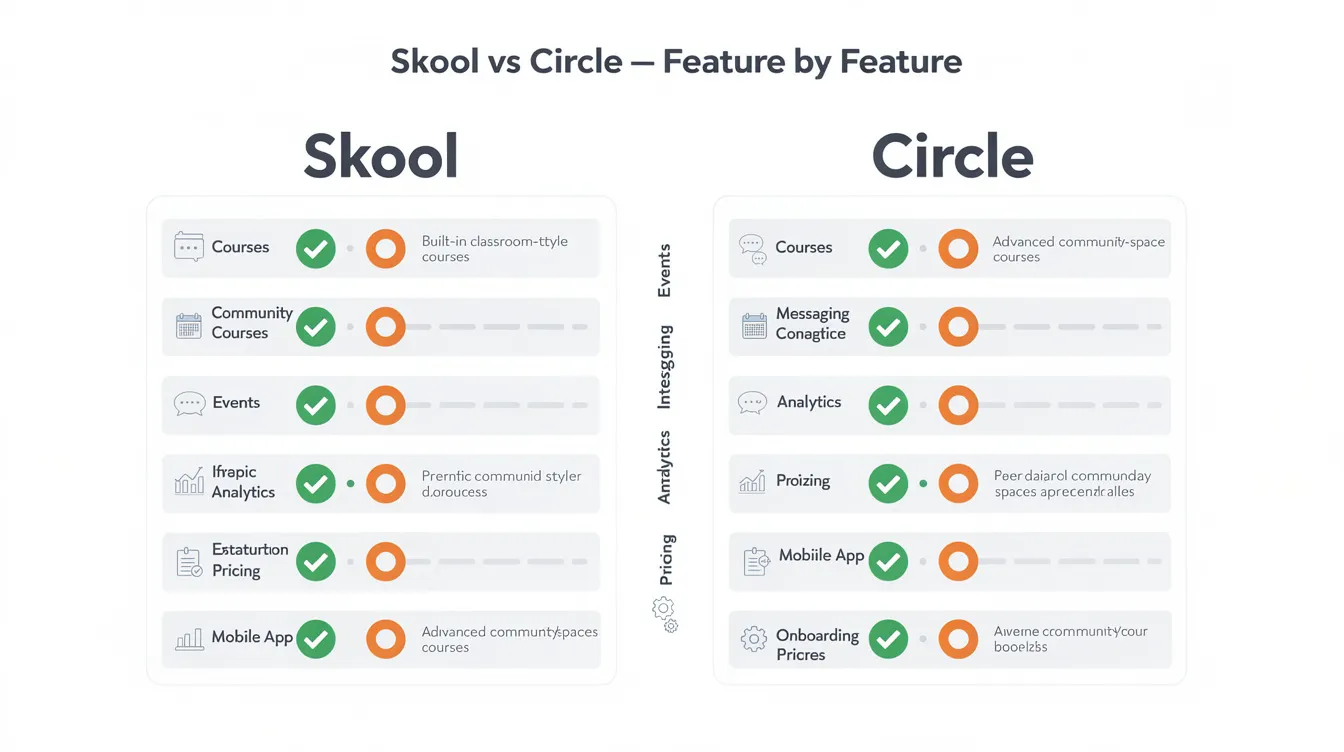
Ease of Use and Setup
Skool's community interface resembles Facebook groups. One feed, predictable tabs (Community, Classroom, Calendar, Leaderboard), minimal configuration. New members understand where to go immediately. Community setup takes minutes, not hours. Skool is built for simplicity and community integration - you can have a functioning membership community running the same day you sign up.
Circle's interface uses a Spaces architecture that requires more planning. Circle utilizes a "Spaces" architecture, allowing communities to be organized into different tiers or topics. You define space groups, set permissions per space, configure workflows and decide how content is organized across tiers or topics. That gives you precision, but the learning curve is steeper. Expect several hours of setup before your community feels ready.
For member onboarding, Skool keeps it straightforward - new members land in Skool's single feed and see activity immediately. Circle requires more intentional onboarding design, though Circle's automation includes onboarding and engagement templates that help guide the experience once configured.
Edge: Skool - faster setup, lower cognitive load, easier for non-technical creators.
Community Engagement
This is where Skool shines. Skool offers gamification with points and leaderboards that create natural participation loops. Members in Skool earn points for engagement which unlocks content, driving daily return behavior. Gamification refers to the use of game-like elements such as points, levels, and leaderboards to motivate participation and reward member activity. Skool's gamification improves daily active members by 40%, and Skool's design creates a strong sense of activity among users. The whole community sees everything in the same feed, which amplifies awareness and makes members engage consistently.
Circle added gamification features in 2025, including leaderboards, and Circle allows awarding custom badges for member achievements. However, gamification on Circle feels layered on rather than core. Unlike Skool, Circle organizes community discussions into multiple spaces using Spaces and Space Groups. This lets you organize discussions by topic, tier or cohort - but it can fragment engagement. Community posts in smaller spaces sometimes feel deserted.
Circle includes built-in profanity filters for moderation and more granular moderation tools (moderator roles per space, upload controls). Skool's moderation tools are simpler. Skool allows bulk inviting members via CSV upload, which helps when migrating from Facebook groups.
Edge: Skool - gamification and unified feed encourage members to participate more naturally with less manual management.
Course Creation and Delivery
Both platforms function as a course platform, but they approach course structure differently.
Skool allows for fast setup of courses and content. Its Classroom feature supports modules and lessons with video and text, completion tracking and level-based access gating. However, Skool's course builder lacks assessments and quizzes, and Skool's course content must be embedded from external platforms since it lacks built in video hosting.
Circle supports native video hosting for course materials and offers three course delivery formats: self-paced, structured, and scheduled. Circle allows quizzes to assess student understanding, and you can set a minimum passing grade. Circle specifically provides better student progress tracking and course space organization. If you want to create unlimited courses with drip scheduling, prerequisites and cohort-based delivery, Circle offers more features.
Neither platform offers native course completion certificates - worth noting if accreditation matters to your coaching program.
Edge: Circle - stronger course tools, native video hosting, assessment capabilities. Skool works for simple online courses but falls short for structured learning.
Pricing and Transaction Fees
Skool vs Circle pricing follows different models.
Skool offers a $9/month Hobby plan with a 10% transaction fee - affordable to start but costly as revenue grows. Skool's Pro plan costs $99/month with a 2.9% transaction fee, making it significantly more cost-effective once you have meaningful revenue. Unlike Circle, Skool includes all features in Pro with no upsell gates.
Circle's Basic plan starts at $49/month with higher transaction fees. Circle charges transaction fees between 0.5% and 4% based on the plan. The Professional plan and Business plan unlock progressively more features - custom domain, white-labeling, advanced workflows. Circle's Enterprise plan costs $399/month with lower transaction fees.
Circle's automation features require the Business plan for full access, so the total cost of getting Circle's best community features can be substantially higher. Hidden costs with Circle can include add-ons for branding, extra seats and storage.
For a creator doing moderate monthly revenue from mid-ticket subscriptions, Skool Pro often delivers better net income. As your needs grow toward branding and workflow automation, Circle's higher spend may be justified.
Edge: Skool - simpler, more cost-effective pricing for small-to-mid creators. Circle wins when premium features justify the investment.
Integrations and Mobile Experience
Skool integrates with Zapier for additional automation capabilities, but Skool's automation is limited to a single welcome message feature. Third party integration options are narrower. Unlike Circle, Skool communities always use the skool.com domain - no custom domain, no white-label option to present your own brand.
Circle can create automated workflows for community management and Circle offers advanced workflow automation features for member engagement. Circle allows custom domains for branding, Circle offers extensive customization options using CSS, and Circle provides white-label solutions for businesses. White-labeling means you can fully customize the platform’s appearance and domain to match your own brand, removing all Circle branding. Circle supports native live streaming and live rooms for event hosting. For live events and group chats, Circle provides more built-in tools.
On mobile, both platforms have apps, but Circle's mobile experience is more polished with stronger branding control on higher plans. Skool's calendar syncs with multiple platforms for event visibility, which is a practical touch for creators running live events.
Edge: Circle - more integrations, better automation, full branding control and superior mobile experience.
Who Should Choose Skool

Skool is ideal for educators focused on member participation who want a fast-launching, gamified community without technical complexity.
Choose Skool if you are:
A course creator or coach wanting a simple paid community with built-in engagement loops
Migrating from Facebook groups and want a familiar, feed-based experience where active members see everything
Running a small community (under 1,000 members) where a single community feed keeps energy high
Prioritizing speed - you want your online business running this week, not next month
Comfortable with Skool's branding and domain constraints in exchange for lower costs
Who Skool is NOT for:
If you need deep customization, your own brand domain, multi-space organization for a large existing community, or advanced LMS features like quizzes and assessments, Skool will feel limiting. Creators comparing Skool or Circle who sell high-ticket offerings above $900 per sale should also factor in Skool's additional platform fee at that threshold.
Who Should Choose Circle
Circle is designed for professional customization and organization. It is selected by companies needing scalable, branded solutions.
Choose Circle if you are:
Building a professional community with multiple membership tiers, cohort groups or topic-based space groups
A business requiring custom domain, white-labeling and a polished, branded mobile experience under your own brand
Running a large community where noise control, rich member profiles, activity scores and moderation tools matter as your community grows
Needing advanced automation and workflows to manage onboarding, engagement and member segmentation
A course creator whose offering depends on structured delivery, native video hosting and assessment
Who Circle is NOT for:
Budget-conscious beginners or free community builders who want plug-and-play simplicity. If you prefer a single community feed over structured spaces, or if transaction fees on thin margins concern you, Circle's complexity and cost may not be justified. Also consider that Circle has a professional and polished feel - but that polish requires investment in setup and ongoing management. Skool has a casual and fast-paced community vibe that some community builders prefer.
Final Verdict: Choose by Your Profile
There is no single answer to whether Skool or Circle is better - it depends entirely on your profile. Use the table below to help decide:
Profile/Need | Skool | Circle |
|---|---|---|
Solo creator or coach launching first paid community | Fast setup, high engagement, low cost | More complex, higher cost |
Established brand/org with multiple products or cohorts | Limited customization, single feed | Structure, branding, automation |
Course-first creator needing robust delivery tools | Basic course tools, no assessments | Advanced course features, video hosting |
Migrating from Facebook groups for familiar energy | Single feed, gamification | Structured spaces, less familiar |
Growing beyond 1,000 active members | Feed can get noisy | Spaces, moderation, segmentation |
Both Skool and Circle are capable community platforms. The right choice is the one that matches your current needs and the direction you are building toward—not the one with more features on a comparison chart.
Frequently asked questions
Skool is better when your priority is high community engagement, gamification and simple setup at a lower price point. Circle is the better community platform when you need structured spaces, custom branding, workflow automation and advanced course tools. There is no universal winner in the Skool vs Circle debate - it depends on your community model and growth stage.
Skool is generally cheaper. Its Hobby plan is the lowest-cost entry point, and its Pro plan includes all features at a fixed monthly rate with competitive transaction fees. Circle pricing starts higher and scales up as you unlock features like white-labeling, custom domains and automation. For creators with moderate revenue, Skool typically costs less overall. Check each vendor's site for current pricing.
For simple online courses built around community discussions and video content, Skool works well. For structured course delivery with quizzes, drip scheduling, multiple formats and native video hosting, Circle wins. If your coaching program requires assessment or cohort management, Circle specifically provides those tools.
Skool's gamified approach - points, leaderboards, level-based content unlocking - drives engagement more organically. Members engage daily because the system rewards participation. Circle can achieve strong engagement but requires more manual effort: seeding content, structuring spaces, configuring workflows. Unlike Skool, Circle's engagement depends more on your management than the platform's mechanics.
Migration is possible but not seamless. Moving community posts, course materials, member data and transaction histories requires manual work. Circle's space architecture does not map directly to Skool's single-feed model, so switching from Circle to Skool means flattening your content structure. Branding assets, custom domain settings and permissions will need reconfiguration. Plan for a transition period and potential loss of some organizational distinctions.