

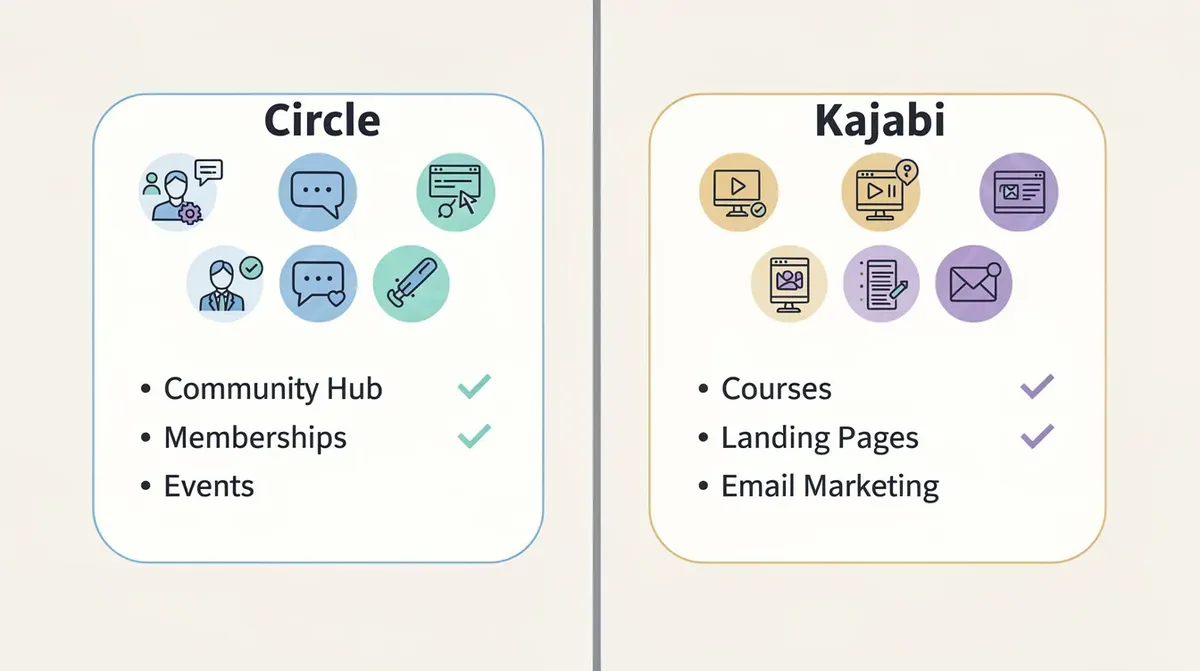
Circle is a community-first platform with integrated course features. Kajabi is an all-in-one platform for selling online courses, with built-in marketing tools. Circle is a community-first platform with integrated course features, built around member interaction, discussions, and live events. Kajabi is an all-in-one platform for selling online courses, with built-in marketing tools, sales funnels, and email marketing capabilities.
This guide is for creators, coaches, and entrepreneurs deciding between Circle and Kajabi for building online communities or selling courses. Understanding the strengths and limitations of each platform will help you choose the best fit for your business model.
The difference between Circle and Kajabi comes down to what sits at the center of your online business.
There's no universal winner in the Circle vs Kajabi debate. If your priority is building an engaging online community where members connect, discuss, and keep coming back, Circle usually delivers better. If you need to sell courses, run email marketing, build landing pages, and automate sales funnels under one roof, Kajabi tends to win.
Just as important - who each is not for. Circle is not ideal if your entire business revolves around course creation with complex marketing automation, affiliate programs, and sales pages. Kajabi is not ideal if community is your primary product, you expect daily threaded discussions and live rooms, or you want to keep costs low for a community-focused model.
This comparison covers ease of use, community engagement, course creation, pricing structure, integrations, and mobile experience - then gives you a clear profile-based verdict for 2026.
Circle vs Kajabi: At a Glance
Here's a side-by-side overview of what matters most when choosing between Circle or Kajabi.
Dimension | Circle | Kajabi |
|---|---|---|
Best For | Membership communities, coaching groups, engagement-heavy businesses | Course creators, coaches, experts needing integrated marketing |
Ease of Use | Beginner-friendly, community-focused interface | More involved setup; steeper learning curve for funnels and automation |
Key Features | Community spaces, live rooms, live events, gamification (leaderboards, badges), discussions, group chats | Courses, quizzes, drip schedules, email marketing, sales funnels, landing pages, affiliate programs |
Pricing Model | Tiered subscription; Circle charges transaction fees ranging from 0.5% to 4% on revenue processed through the platform | Tiered subscription; Kajabi does not charge any transaction fees on its plans |
Free Plan / Trial | No free plan; 14-day free trial | No free plan; 14-day free trial |
Mobile App | Native mobile apps on every plan; branded apps on higher tiers | Kajabi-branded app included; Kajabi's branded app available on Pro plan or as paid add-on |
The transaction fees distinction is one of the sharpest differences. Circle charges transaction fees that scale down as you move to higher plans, while Kajabi keeps things predictable with zero platform transaction fees beyond standard payment processor costs. For pricing specifics and current plan details, check each vendor's site directly. |
Round by Round Comparison
Ease of Use
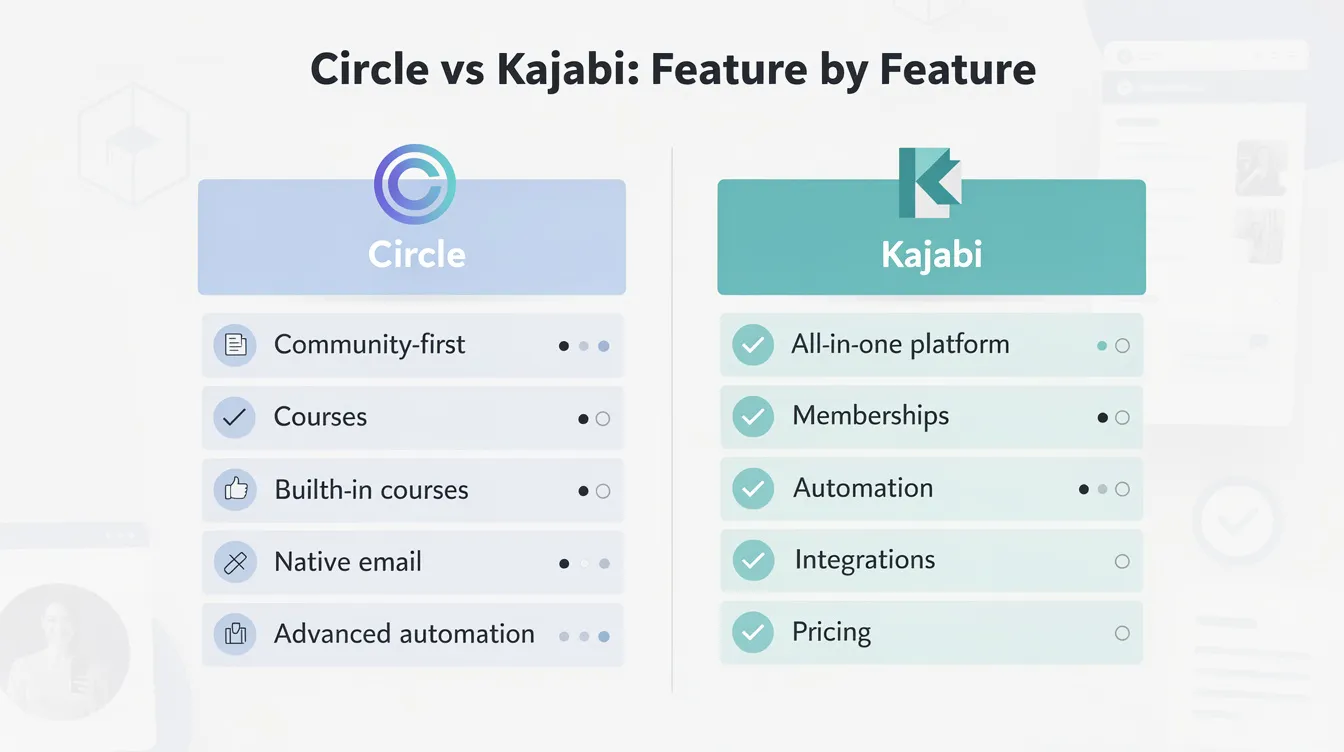
Circle's interface is beginner-friendly and polished. Setting up a community space, launching a live room, or scheduling virtual events is straightforward - you can get to member interaction and value quickly. Circle's dashboard loads quickly without lags or bugs, and the overall navigation is clean and clutter-free. Circle makes it easy to go from signup to a functioning community space in a single session.
Kajabi's onboarding tends to require more pieces. You're configuring a website builder, building sales funnels, setting up email marketing sequences, and organizing course content. Kajabi's interface feels modern but can overwhelm new users with its breadth of tools. It's more powerful in scope but demands more time before you see results.
For course creation specifically, Kajabi offers more polished plug-and-play tools - structured modules, quizzes, drip content. But if your first priority is getting members engaged and talking, Circle gets you there faster.
Edge: Circle - based on beginner-friendliness and time to first value.
Community Engagement and Member Experience
This is where the sharpest difference between Circle and Kajabi shows. Circle provides features for fostering community interaction like discussion forums and live events. Its native tools - community spaces, threads, space groups, live rooms, group chats, and discussions - are purpose-built for ongoing community engagement. Circle includes gamification features like leaderboards and badges, activity scoring, and rich member profiles that keep members engaged day after day. Circle provides a social experience similar to platforms like Slack or Facebook Groups, but purpose-built for serious community businesses.
Unlike Kajabi, Circle treats community as the product, not just a community layer added to a course. You can organize your entire community into separate space groups, run live events natively, and build community posts into structured discussions across other community spaces. Circle is considered more interactive for member engagement and supports member interaction and community-based learning.
Kajabi's community feature serves as an add-on rather than a central aspect. It functions more like a community tab within a broader course platform. Kajabi allows launching challenges to boost member engagement, and the experience improves with branded app plans, but those come at a higher cost. For daily interaction and retention, Kajabi's community tools remain secondary to its marketing and course roots.
Edge: Circle - for community building and member engagement by a clear margin.
Course Creation and Learning Features
If course creation is your primary focus, Kajabi offers a robust LMS. You get structured lesson modules, video and text content support, drip schedules, module locking, and completion tracking. Kajabi provides built-in assessment tools and certificates, making it a comprehensive solution for self-paced evergreen online courses. Kajabi offers an AI course outline generator for quick structuring, and Kajabi allows selling courses as standalone products with polished course pages. For course creators who need to engage students through structured learning materials, it's hard to beat.
Circle's courses are integrated within community spaces - a separate space or course space within the broader community experience. This works well for cohort-based learning, community-driven courses, and live cohorts, but lacks some LMS refinements. Circle supports embedding content from over 700 platforms, which adds flexibility to course lessons, and Circle's post editor is robust for mixing content types. However, for heavier testing, certificates, and structured assessment, a third party tool is often still needed.
Kajabi is better suited for course businesses and digital products where the learning path itself is the core deliverable.
Edge: Kajabi - for comprehensive course content delivery and educational features.
Pricing Structure and Value
Circle vs Kajabi pricing works differently in 2026, and the true cost depends on your business model.
Circle's pricing starts at $49/month for its Basic plan. Circle's mid-tier plan costs $99/month, cheaper than Kajabi's $149/month at the same level. Kajabi's lowest tier starts at $69/month. Kajabi's Pro plan costs $399/month, same as Circle's Enterprise plan.
Here's the catch - and it comes with a few caveats. Circle charges transaction fees ranging from 0.5% to 4%, meaning the platform takes a cut of your revenue processed through it. On lower plans, that percentage is higher. As you scale, the rate drops, but it's a real cost for a paid community pulling in significant revenue. Kajabi does not charge any transaction fees on its plans, which makes costs more predictable for high-revenue course businesses.
Circle's Marketing Hub is an add-on for email broadcasts, while Kajabi includes email marketing and sales funnels as built-in features. Add-ons for branded apps, additional storage, and advanced features can shift the math on both platforms. Circle has plans that scale with community activity and membership size, which benefits community builders who grow gradually.
For specific, up-to-date pricing on both platforms, check the vendor's site - plans and inclusions change.
Edge: Depends on usage - Kajabi offers more predictable all-in-one value for course + marketing models; Circle pricing favors engagement-heavy, community-first businesses.
Integrations and Mobile Experience
Circle offers robust API access, CSS/JS customization, and workflows triggered by member behavior. Circle's automation can send welcome messages to new members, though Circle offers basic automation workflows without conditional logic. For deeper marketing automation, most creators pair Circle with external tools. Circle allows embedding content from over 700 platforms, and you can set up a custom domain. Native mobile apps are included on every plan, giving your entire community a mobile-native experience.
Kajabi supports advanced automation with if/then logic on higher tiers, with Kajabi's automation including workflows for emails and events. Kajabi supports multiple payment gateways including Apple Pay and Google Pay, and Kajabi allows upsells and order bumps during checkout - advanced marketing features that Circle doesn't match natively. Kajabi's branded app is available on its Pro plan or as an add-on, letting you have your own listing in the App Store with push notifications and in-app purchases. Kajabi also includes unlimited landing pages and a page builder on most plans.
Circle's automation is focused on community management tasks. Kajabi's is focused on sales and marketing hub operations.
Edge: Mixed - Kajabi for built-in marketing tools and payment flexibility; Circle for technical extensibility, community-first mobile experience, and API access.
Who Should Choose Circle

Choose Circle if you're building a membership site platform where community is the product - not just a wrapper around a course. Circle is ideal for membership communities and coaching groups, professional networks, paid community models, and creators who want members engaged through daily discussions, live events, and community posts.
Circle communities work best when your revenue comes from recurring subscriptions, cohort events, and deep member interaction. Circle offers complimentary course migration for qualifying plans, making the switch smoother if you're moving from another online course platform.
Circle is not ideal if you need built-in sales funnels, advanced email marketing capabilities, or a comprehensive website builder. It's also not just a community platform for the cheapest possible use case - transaction fees and add-on costs add up on lower tiers.
Who Should Choose Kajabi
Choose Kajabi if you're a course creator who needs an all in one platform to sell courses, build marketing funnels, run email sequences, and manage affiliate partners. Kajabi offers a comprehensive solution for creators whose online business revolves around digital products, coaching programs, and knowledge monetization.
Kajabi makes sense when you're scaling a course business with growing contact lists and need landing pages, sales pages, and checkout optimization without bolting on external tools. Both Kajabi and Circle can handle courses, but Kajabi does it with more depth and marketing integration.
Kajabi is not ideal if online community building is your primary goal. Kajabi's community tools are improving but remain a secondary feature. If you want live rooms, rich threaded discussions, and deep gamification, you'll find Kajabi's community experience limiting.
Final Verdict by Creator Profile
The Circle vs Kajabi decision isn't about which platform is better in the abstract - it's about which matches your business model in 2026.
If community is your product - you run a paid community, membership network, or coaching group where most of your value comes from member-to-member interaction, live events, and ongoing engagement - Circle is the stronger fit. It's built for community builders who want members active daily.
If courses and marketing are your engine - you sell online courses, need marketing automation, sales funnels, email marketing, and want everything under one roof - Kajabi is the more practical choice. It's a comprehensive solution for course creators who don't want to stitch together multiple tools.
If you need both equally, evaluate which side you'd rather compromise on. Both Circle and Kajabi are expanding into each other's territory, but their core strengths remain distinct. Most creators find one platform clearly fits better once they're honest about what drives their revenue.
Both platforms offer 14-day free trials. Test each with your actual content and community to see which workflow feels right before committing.